Alan's Factory Outlet Publishes a November 2026 Storage Stress Index for 196 U.S. Cities
Alan's Factory Outlet published a November 13, 2026 study combining a 1,004-adult March 2026 survey with a Storage Stress Index for 196 U.S. cities, led by New York City, Honolulu, and Milwaukee.
Disclosure: This page may contain affiliate links. They do not influence our editorial conclusions. Read the disclosure.
Alan's Factory Outlet Publishes a November 2026 Storage Stress Index for 196 U.S. Cities
On November 13, 2026, Alan's Factory Outlet published "Where Americans Need More Storage Solutions", a company study by Alan Bernau Jr. The page combines a national consumer survey with a city-level Storage Stress Index. It is a dated official research post, not a product launch, a price change, or a new delivery-area announcement. This news brief summarizes the figures and methods the company itself published, with attribution and a link back to the original page.

What the company says it measured
The study has two parts. The first is a Storage Stress Index covering 196 U.S. cities with populations of 100,000 or more. Alan's Factory Outlet says each city was ranked on three equally weighted factors, then averaged and scaled from 0 to 100, with 100 assigned to the highest-scoring city:
- Self-storage availability, from U.S. Census Bureau County Business Patterns data (2023), shown as establishments per 100,000 residents.
- Housing density, from American Community Survey 1-year housing-unit counts and Census Gazetteer land area.
- Median home square footage, from 185,254 Zillow residential listings over the prior 12 months, including listed and recently sold single-family homes, townhomes, and condos.
The second part is an online survey of 1,004 U.S. adults conducted in March 2026. The company reports an average respondent age of 40, a gender split of 50% women and 49% men, and a generational mix of 53% millennials, 24% Gen X, 16% Gen Z, and 8% baby boomers. By residence, 65% lived in a single-family home, 23% in an apartment, 5% in a condominium, 3% in a mobile or manufactured home, and 4% in another type of home. Because millennials are more than half of the sample, some of the moving and financing figures may run higher than they would in a sample that matches the national age mix. The company does not present the survey as a census of every U.S. household.
The headline findings
The company's key takeaways, as published on November 13, 2026, are:
- 52% of Americans who lack storage had considered moving to a new home just for more space, and 48% of that group planned to move within two years.
- Women were more likely than men to avoid inviting guests (34% vs. 21%), hosting family gatherings (30% vs. 17%), and making large purchases (30% vs. 19%) because of clutter.
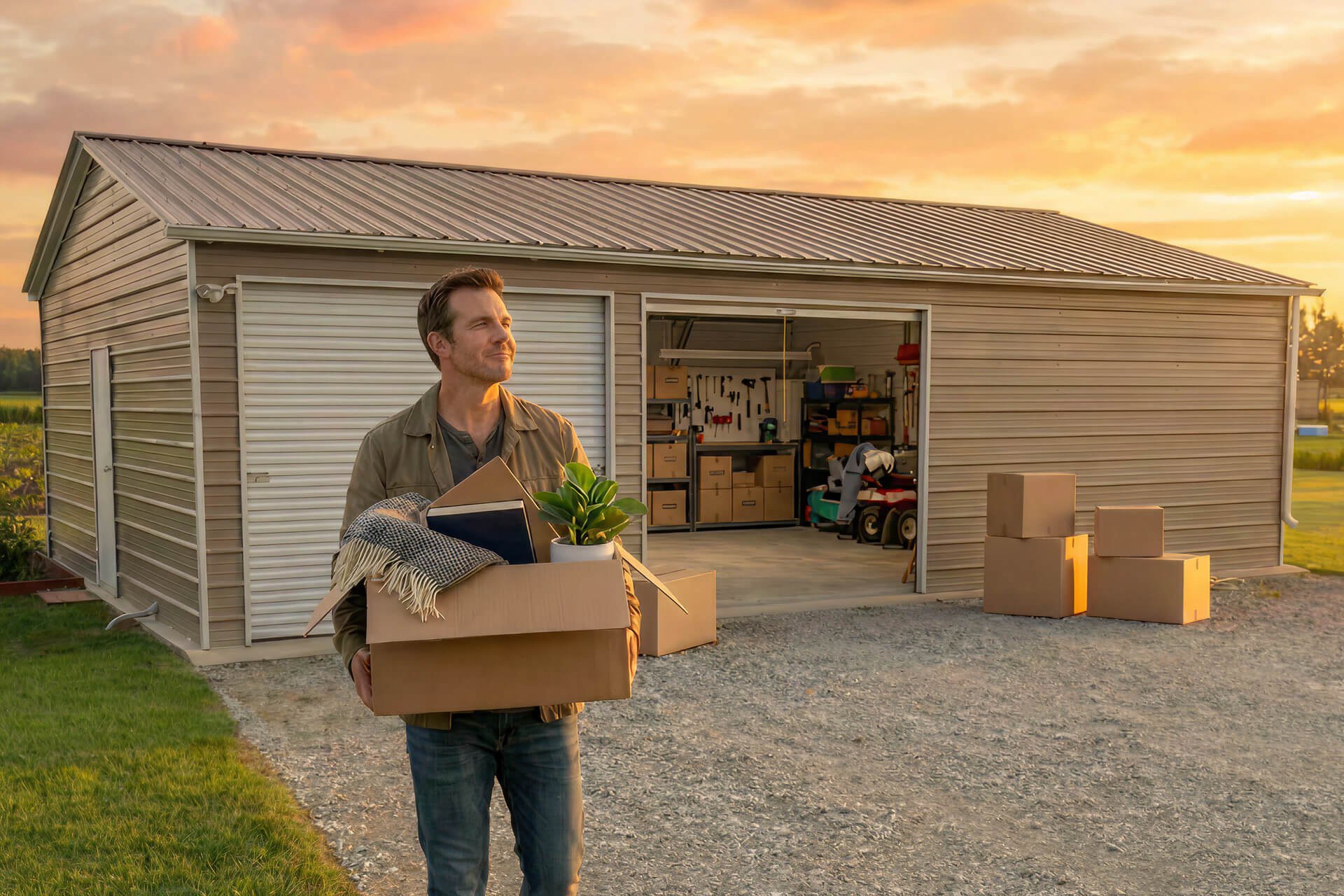
- Nine in 10 respondents who lacked storage would choose an at-home solution over renting off-site storage.
- The most storage-stressed cities in the index were New York City, Honolulu, and Milwaukee.
- Seven of the 10 least-stressed cities were in Texas or Arizona, including Denton, Frisco, and McKinney, Texas, and Peoria, Scottsdale, and Surprise, Arizona.
- Three in four Americans said limited storage affects their stress levels, including 31% who described a moderate or major impact.
Further down the page, the company adds that 57% of those surveyed said their home does not have enough storage. Among people who reported a lack of storage, 84% said the home feels cluttered. Overflow, when it was located, was most often in closets (20%) and bedrooms (20%), then living or family rooms (15%), kitchens or pantries (13%), garages (11%), and basements (9%).
The city index is explained in more geographic detail. New York City ranked first, with the highest housing density in the set at 12,439 units per square mile. Honolulu ranked second, with the smallest median home size at 1,064 square feet. Milwaukee was third. Seattle, in fourth, was flagged for the fewest self-storage facilities per 100,000 residents (3.2). The top 10 most-stressed cities averaged a median home size of 1,340 square feet and 11.9 self-storage facilities per 100,000 residents. San Francisco landed at No. 10 with high density even though the company says it ranked among the better cities for self-storage availability. Regionally, 7 of the top 10 most-stressed cities were in the Northeast or Midwest, and Northeast cities averaged a stress score of 74, compared with 41 in the South.
How to read a brand-sponsored study
Alan's Factory Outlet sells metal buildings, garages, carports, and sheds, and the closing section of the article argues that a metal shed or detached garage can add space without a recurring monthly storage bill. That is the company's commercial conclusion, not an independent finding from Census or Zillow. The survey and index can still be cited if you keep the source, date, methods, and sample shape in view.
The page includes a fair-use statement: the data and insights may be used for noncommercial purposes if the study is attributed and a link to Alan's Factory Outlet is included. This brief follows that request.
If you are using the study as a reason to shop the brand, the next useful documents are not the infographic. They are the shopping guide to deposits, delivery states, and warranties, the site-prep and permit how-to, and the official terms and help center. Prices, service areas, and installation rules should be confirmed on a current product page or by phone at 1-800-488-6903 (Monday-Friday, 8-6 Eastern).
References
- Where Americans Need More Storage Solutions, Alan Bernau Jr, published November 13, 2026, accessed November 18, 2026
- Alan's Factory Outlet homepage, accessed November 18, 2026
- Alan's Factory Outlet terms, accessed November 18, 2026
Update
Where to go next
Meet your guide
Brands Review
author
What to read next
 Public Storage Reservations, Move-In Totals, and Climate-Control Limits A research guide to official Public Storage reservation and pricing caveats, first-month totals, insurance language, an administrative-fee figure that can apply, and the climate-co...
 Public Storage Small vs. Medium Units, Using Official Size-Guide Figures A research comparison of official Public Storage small and medium size-guide examples, including 5-by-5 through 10-by-15 figures, cubic-foot totals, and the caveat that actual unit... How to Move Out of a Public Storage Unit: Official Notice and Billing Rules How official Public Storage move-out guidance describes a seven-day notice, emptying and cleaning the unit, removing the lock, month-to-month billing, and the statement that there...