XCEL Life and Health Standard vs. Premier: What the Extra Study Tools Actually Buy
Compare official state-dependent package prices, the shared three-part course, Premier flashcards and recorded review, staged access, and the limits of the conditional refund promise.
Disclosure: This page may contain affiliate links. They do not influence our editorial conclusions. Read the disclosure.
Our pick
- See price at XCEL Solutions
Top pick
XCEL Solutions
XCEL Solutions provides insurance education and exam-preparation courses, including Life and Health packages, a three-part study program, and Rubi study support...
XCEL’s Life and Health packages present a familiar buying problem: pay for the core course, or spend more on additional study formats and a conditional refund promise. The useful distinction is not “basic education versus a guaranteed license.” Both packages are education products. A state regulator decides licensing eligibility, and a separate state examination remains a different assessment from an XCEL course exam.
This comparison uses XCEL’s public package, support, and policy pages, checked November 18, 2026. It does not report an enrolled student’s experience, independent exam results, or a measured improvement in pass probability. The decision is whether the documented extras fit your study habits and actual state requirements.

Start with the right state and license line
Choose the state and intended authority before comparing package names. “Life and Health” is a convenient course category, but state licensing structures and education obligations are not identical. A package sold for one jurisdiction should not be assumed to satisfy another jurisdiction’s requirements merely because both discuss insurance policies and underwriting.
XCEL’s national Life and Health page lists Standard at $199–$249 and Premier at $299–$349, explicitly saying prices vary by state. These are published ranges, not a quote for every applicant or a promise of a particular checkout total. Compare the actual state-specific selections side by side. Do not infer that an unavailable package can be purchased at the lowest number in the range.
The page also says the state examination fee is not included in the course price. Application charges, fingerprinting where required, and any vendor processing fees belong in a separate budget. Buying Premier does not prepay every step between studying and receiving a license.
What Standard already supplies
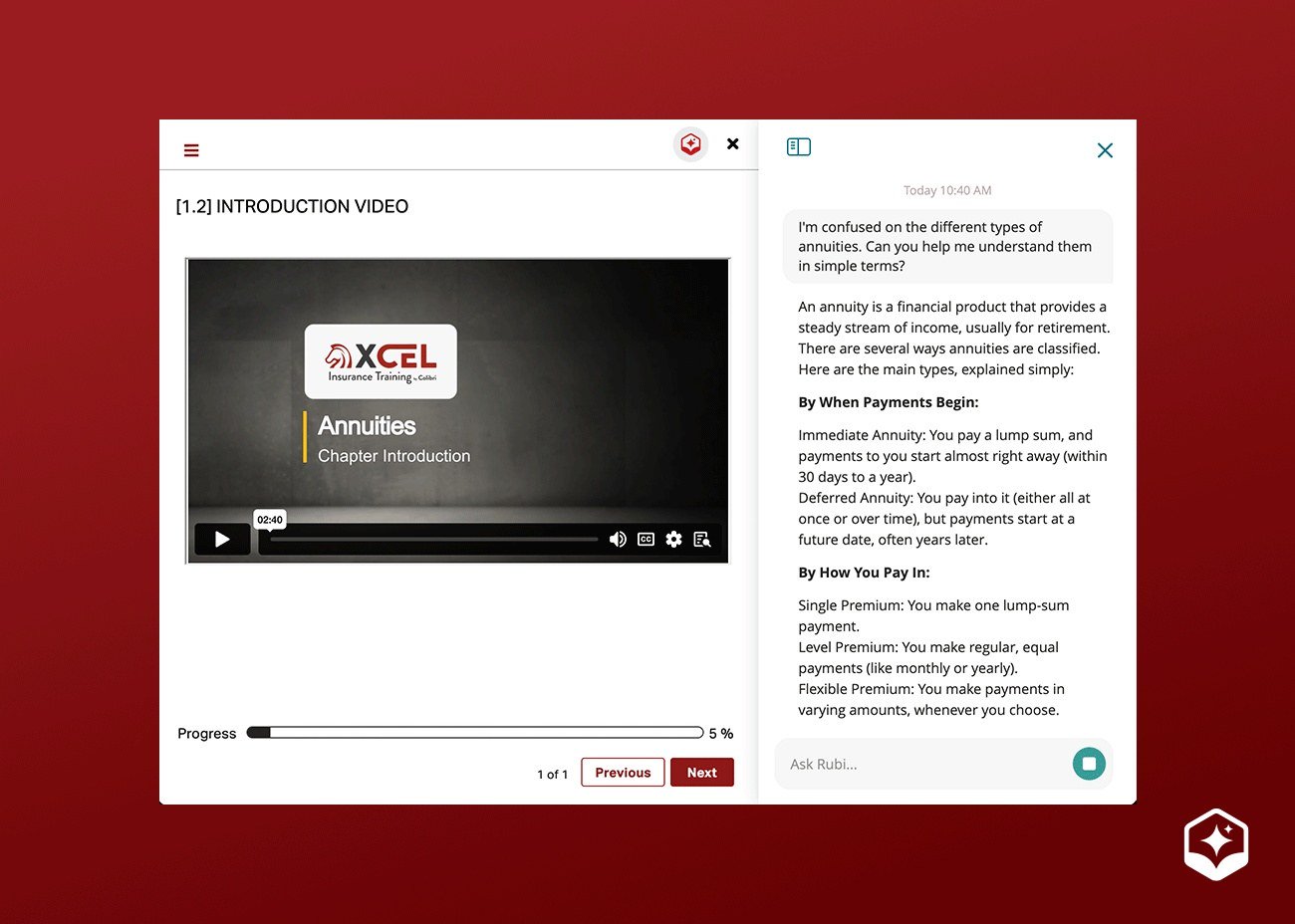
The central offering is XCEL’s three-part training system: the initial course, a more focused Prep Review course, and exam simulators. The package descriptions present this structure as the foundation rather than a Premier-only upgrade. Rubi, XCEL’s AI study partner, is also described as part of the lesson experience, not something that requires choosing the more expensive tier just to ask study questions.
The initial course covers foundational material with resources such as videos, review notes, and chapter exams. Prep Review narrows the material toward the examination outline. The simulator stage then provides three sequential assessments weighted by topic. This distinction matters when comparing prices: the cheaper package is not simply a book while the expensive package alone supplies a complete practice sequence.
Standard is therefore a reasonable candidate for someone who reliably works through assigned material, makes useful notes, and already has an effective method for recalling definitions. That is an editorial fit judgment, not evidence that Standard produces equivalent outcomes for every learner. Public feature lists cannot establish how either package will work for a particular person.
What Premier adds—and what each extra is for
XCEL explicitly identifies three Premier additions: more than 800 flashcards, a recorded livestream exam review, and its Pass Guarantee. The first two change the ways you can revisit material. The third is a conditional financial policy; it does not teach the content by itself.
Flashcards are most useful when you will actually retrieve an answer before turning the card over. A learner struggling to distinguish related terms may value a prepared set. Someone who learns primarily by writing explanations may find a personally maintained question list more useful. The published quantity is a resource count, not a measure of mastery or a promise that the cards reproduce actual examination questions.
The recorded review offers another presentation of material that can be paused and revisited. “Recorded livestream” should not be mistaken for a private live tutoring appointment, a guaranteed appointment with an instructor, or a current examination briefing tailored to your circumstances. Check the actual state package’s description rather than purchasing on an assumption about real-time interaction.
If your normal behavior is to collect study resources without using them, Premier’s larger toolkit may add complexity rather than solve the problem. Conversely, if you consistently learn through alternating written recall and spoken explanations, the extra formats address a concrete need. Assign each extra a planned role before paying for it.
Read the access description as stages, not an open-ended library
The feature table describes Extended Access as 30 days for the Pre-licensing Course, followed by another 30 days for Prep Review and Exam Simulators. That is not the same statement as unrestricted access to every component for 60 days from any date you choose.
Before enrollment, establish how your selected product starts each access period and how those dates appear in the student dashboard. XCEL’s support page says extensions can be purchased there, but the public guidance reviewed does not establish a universal extension price. Do not budget on free extensions or assume a later exam appointment automatically extends your course.
A useful comparison therefore includes calendar fit. Someone with an unpredictable work schedule should check access and extension terms before choosing either tier. Premier’s additional tools do not remove the need to complete the required sequence while access is available. No package description can guarantee that a particular learner will finish within a fixed number of evenings.
The guarantee is not a risk-free trial
Premier’s Prepared to Pass Promise has requirements beyond purchasing the package. The separate policy requires completion of all three parts, at least 85% on the final simulator by the second attempt, and taking the state exam within 48 hours of completing that simulator. A claim after the first failed state examination must be submitted within two business days with the required evidence.
Those conditions make the promise relevant to a specific, organized study-and-exam sequence. They do not mean every unsuccessful customer gets a refund. The policy excludes, among other situations, company-paid packages, later state-exam retakes, no-shows, and being turned away from the exam. Read the full terms before assigning a dollar value to the promise.
Ordinary cancellation is different again. XCEL’s regular refund page says accessing any course in an individual purchase or package makes that course or entire package nonrefundable under the ordinary policy. Premier should not be treated as an opportunity to open everything, decide whether you like the interface, and rely on a general satisfaction refund. The separate policy comparison explains those two routes without merging their rules.
State education requirements can change the buying calculation
A national feature label is not a substitute for a regulator’s current instructions. California illustrates why: its 2026 changes removed the 20-hour prelicensing education requirement for specified producer lines while retaining the 12-hour California insurance code and ethics requirement before license issuance. Optional exam preparation and a required approved ethics course are different purchases conceptually, even if a provider bundles them.
XCEL’s package table describes Code & Ethics inclusion where required. Confirm what the exact California selection contains and check approval for the required component rather than calling every commercial exam-preparation lesson regulator-approved. Our California guide separates those obligations. Applicants elsewhere should perform the same regulator-first check for their own line and residency situation.
A practical choice between the two tiers
Consider two hypothetical learners. The first can explain missed questions in writing and maintains a disciplined review routine. If the selected Standard package includes the needed state material, its core sequence may be sufficient for that learner’s intended preparation method. There is no need to buy Premier merely because the word “Standard” sounds incomplete.
The second learner regularly benefits from recorded explanations and uses flashcards throughout a course. Premier’s documented additions have a clear purpose in that routine. Even then, evaluate the purchase without assuming the promise will pay out. Eligibility depends on performance, timing, funding source, and evidence, not simply an eventual failed result.
Before purchasing, save the selected state, package name, itemized price, included components, and access terms. Resolve uncertainty before opening a course because ordinary refund eligibility changes with access. Confirm examination arrangements separately; a course enrollment is not an exam reservation.
If those checks point toward XCEL, the XCEL Solutions brand page collects our related guides, and the official-site route leads through our joined tracking link. Brands Review may earn a commission through that route. Our recommendation remains conditional: choose the tier whose documented tools you will use, not the tier whose marketing sounds most like a licensing outcome.
References
Meet your guide
Lipeiguan
author
What to read next
XCEL Refunds vs. the Prepared to Pass Promise: Two Different Policies, Two Different Clocks Read ordinary cancellation rules alongside Premier’s separate conditional first-exam-failure policy, including access restrictions, fees, simulator attempts, short claim deadlines,... XCEL and the Texas General Lines Life and Health License: A First-Time Resident’s Roadmap Map optional XCEL preparation to Texas’s resident individual General Lines Life, Accident, Health and HMO route: correct exam, fingerprint portal, application window, fees, and sco... XCEL and California Life and Health Licensing: Optional Exam Prep, Required Ethics, and the State Exam Separate California’s 2026 education change, the retained 12-hour ethics requirement, optional XCEL preparation, current remote-exam transition dates, and conflicting fingerprint s...