How to Use XCEL’s Three-Part Study Program Without Confusing Practice With Exam Readiness
A practical, source-based workflow for lessons, Prep Review, sequential simulators, Rubi questions, error logs, locked tabs, and a realistic study calendar without promised results.
Disclosure: This page may contain affiliate links. They do not influence our editorial conclusions. Read the disclosure.
Our pick
- See price at XCEL Solutions
Top pick
XCEL Solutions
XCEL Solutions provides insurance education and exam-preparation courses, including Life and Health packages, a three-part study program, and Rubi study support...
What this guide covers
- 01Set up two records before the first lesson
- 02Use Part 1 to build explanations, not just notes
- 03Understand why the next tabs may still be locked
- 04Turn Prep Review into a targeted repair stage
- 05Use Rubi to expose a gap, then verify the answer
- 06Interpret simulator results without overvaluing repetition
The most useful way to approach XCEL is as a sequence of different learning tasks, not a race to turn every progress indicator green. Its public description separates foundational coursework, focused Prep Review, and three sequential exam simulators. Each stage can reveal a different problem: unfamiliar concepts, weak prioritization, or difficulty applying information without prompts.
This guide turns those documented features into a practical study workflow. The planning methods below are editorial suggestions, not an XCEL-mandated timetable or proof of better examination results. We reviewed public guidance on November 18, 2026; we did not enroll in a course or observe a student account.

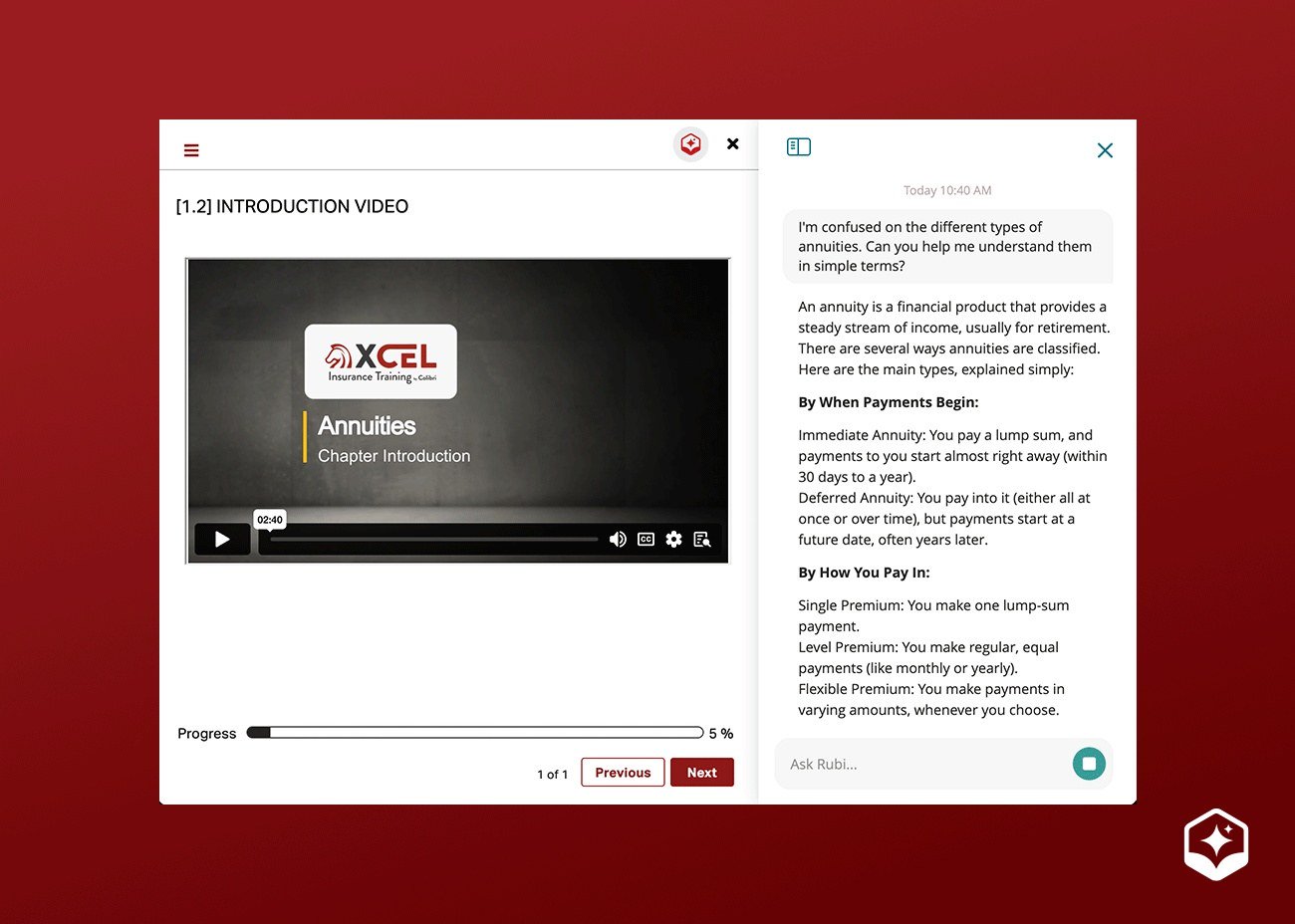
The illustration comes from the provider’s own demonstration, not a Brands Review session. An interface image can show where a tool appears, but it cannot establish the accuracy of every answer or predict a student’s results.
Set up two records before the first lesson
Keep an administrative record separate from a learning record. The administrative record should contain your selected state and license line, course access dates, examination-provider instructions, and any required education certificate. It answers whether you are using the correct product and following the applicable process.
The learning record should contain questions you cannot yet explain, concepts you confuse, and examples you create while studying. It answers whether you understand the material. Mixing these records makes it easy to confuse a completed administrative requirement with readiness for a separate state examination.
Check the relevant regulator’s examination outline before designing your review priorities. XCEL describes state-specific content, but the regulator and examination vendor remain the sources for the current examination scope and appointment rules. A study dashboard is not a licensing portal, and a high course score does not establish eligibility for a license.
Use Part 1 to build explanations, not just notes
XCEL’s initial course supplies the foundation through resources including lessons, videos, review notes, and chapter exams. A useful personal routine is to finish a manageable section, close the explanation, and restate its main idea in ordinary language. Then reopen the material and correct the gaps.
For example, you might write separate definitions for policyowner, insured, and beneficiary, then describe how those roles can differ in a hypothetical policy. This is a learning exercise, not an example of an actual state examination question. If your explanation silently treats all three as the same person, you have found something concrete to revisit.
Keep notes selective. Copying every paragraph produces a second textbook without showing which ideas need work. Instead, record a distinction you missed, the relevant lesson location, and a brief explanation of why the distinction matters. This makes the later review stage more useful than rereading an undifferentiated stack of pages.
Where a course has required progression or time rules, follow those rules. Offline reading may help understanding, but it should not be assumed to count toward tracked education requirements. The exact requirement depends on the state and course, not on a general productivity method suggested here.
Understand why the next tabs may still be locked
XCEL’s support page says Prep Review and Simulated Exam tabs unlock after completion of the Pre-licensing Course and its exam. The public program description similarly places Prep Review after Part 1. This is a structured sequence rather than a promise that every resource is immediately available after purchase.
If a tab remains unavailable, first check the completion status of the preceding course and exam. Save the course name and the exact message before contacting support. Avoid opening unrelated courses in an attempt to force the correct tab to appear; XCEL discourages working in multiple courses simultaneously and warns of potential regulatory issues.
A course certificate, where applicable, can be found through the course or Transcript after the required work and examination are completed. That document records education completion. It is not a state license, an authorization to transact insurance, or proof that a regulator has approved your application.
Turn Prep Review into a targeted repair stage
XCEL describes Prep Review as more streamlined content aligned to the state examination outline. Treat that as an opportunity to connect the larger syllabus with the specific weaknesses you recorded earlier. Do not simply restart the original course at equal intensity across every topic.
One workable error log has four fields: the concept, your mistaken reasoning, the corrected explanation, and a new example. The new example is important. Recognizing a familiar sentence is easier than using the same principle when the names or circumstances change.
Sort errors by cause rather than only by chapter. A vocabulary error calls for a different response from overlooking a qualification in a question. A weak definition may need recall practice; a distinction between similar concepts may need a side-by-side explanation. These are study suggestions, not claims about XCEL’s scoring algorithm or the content of a particular examination.
XCEL says review notes are generally downloadable immediately, but its support page identifies New Jersey and North Carolina as exceptions where completion of prelicensing and the comprehensive exam comes first. Do not assume a missing download is a universal technical fault or purchase a duplicate product before checking the applicable course instructions.
Use Rubi to expose a gap, then verify the answer
Rubi is presented as an AI study partner within the lessons, offering explanations, examples, practice questions, and language support. Productive requests are specific: “Explain the difference between these two terms,” or “Give me a new example and wait for my explanation before showing an answer.”
After using the explanation, compare it with the course material. If a response concerns a legal deadline, licensing qualification, or state-specific rule, verify it against the current regulator or approved course material as appropriate. An AI explanation should not become the sole authority merely because it is expressed confidently.
Translation can make a concept easier to understand, but it does not establish that the state examination is available in that language or that translated terminology matches the vendor’s exact wording. Confirm examination-language options directly with the examination provider. XCEL’s support guidance also distinguishes Rubi from the course and instructor; round-the-clock AI access is not the same service as round-the-clock human tutoring.
Interpret simulator results without overvaluing repetition
XCEL describes three topic-weighted simulators that unlock in sequence and permit unlimited retakes for learning. On an initial attempt, use the conditions specified by the tool and avoid looking up answers if your goal is to identify gaps. Then review why each missed answer was wrong before attempting the next assessment.
A repeated high score can reflect improved understanding, familiarity with the particular questions, or both. Check whether you can explain the underlying concept without recognizing the wording. Keep the first attempt in your record rather than replacing it mentally with the best result after many repetitions.
Unlimited study retakes and Premier’s Prepared to Pass Promise are separate matters. The promise has a final-simulator score requirement tied to the first two attempts, plus other timing and claim conditions. If that policy affects your purchase, read it before taking the relevant assessment. Do not assume unlimited retakes for practice means unlimited attempts count toward a financial-policy condition.
Build the calendar around constraints, not a promised finish date
XCEL’s package page describes staged access: 30 days for the initial course, then another 30 days for Prep Review and simulators. Confirm the actual dates and triggers for your selected product. Its support page says extensions can be purchased in the student dashboard; it does not justify assuming an extension will be free or priced identically for everyone.
Work backward from a realistic examination appointment, leaving space for unresolved concepts and administrative tasks. Allocate sessions to particular outputs—such as explaining a weak topic or reviewing an error log—rather than promising yourself a license after a fixed number of days. Appointment availability, required education, your preparation, and regulatory review are separate constraints.
Before a study session, use a compatible setup. XCEL recommends Chrome or Firefox, advises avoiding Safari, and flags potential difficulties with Chromebooks or devices below 8 GB of RAM. Those are provider recommendations, not a declaration that every other device must fail. It also advises logging out of another device before switching devices. If problems persist, preserve the error details and use official support rather than weakening browser security settings.
The goal is a defensible next step, not an impressive progress percentage. Continue when you can explain weak concepts, have completed applicable course requirements, and have checked examination logistics independently. Our XCEL brand hub links to the state-specific guides. If you choose to enroll, the official-site link uses an affiliate tracking route that may earn Brands Review a commission; it does not change any regulator’s requirements.
References
Meet your guide
Lipeiguan
author
What to read next
XCEL Refunds vs. the Prepared to Pass Promise: Two Different Policies, Two Different Clocks Read ordinary cancellation rules alongside Premier’s separate conditional first-exam-failure policy, including access restrictions, fees, simulator attempts, short claim deadlines,... XCEL and the Texas General Lines Life and Health License: A First-Time Resident’s Roadmap Map optional XCEL preparation to Texas’s resident individual General Lines Life, Accident, Health and HMO route: correct exam, fingerprint portal, application window, fees, and sco... XCEL and California Life and Health Licensing: Optional Exam Prep, Required Ethics, and the State Exam Separate California’s 2026 education change, the retained 12-hour ethics requirement, optional XCEL preparation, current remote-exam transition dates, and conflicting fingerprint s...